Firecracker Pickled Cauliflower: Crispy, Spicy, Garlicky, and Dangerously Addictive
Cauliflower has spent the last decade quietly taking over menus and grocery store shelves — cauliflower rice, cauliflower pizza crust, cauliflower wings, cauliflower steaks. It has become the vegetable equivalent of a blank canvas, absorbing whatever flavor you throw at it while contributing a satisfying, substantial bite that few other vegetables can match. Firecracker Pickled Cauliflower takes that quality and pushes it to its most exciting conclusion: bite-sized florets, brined in a fiery, garlicky, dill-spiced liquid until they become something genuinely addictive — crispy, tangy, spicy, and impossible to eat just a few of.
This is not the soft, vinegary cauliflower you might remember from a sad antipasto jar. This is bold, crunchy, deeply flavored cauliflower that earns the word “firecracker” honestly. Jalapeño and serrano peppers bring layered heat. Smashed garlic infuses every floret with savory depth. Dill, mustard seeds, and black peppercorns build a brine with real complexity. And the cauliflower itself — naturally dense and sturdy — holds its crunch through the entire pickling process in a way that softer vegetables simply can’t.
At around 30 calories per serving, this is one of the most rewarding low-calorie snacks you can make. Twenty minutes of active work, a few days of patience, and you have a jar that disappears from the refrigerator faster than almost anything else in it.
This guide covers everything: why cauliflower is uniquely suited to pickling, a complete ingredient breakdown, step-by-step instructions, tips for maximizing crunch and heat, and every way to use a jar once it’s ready.
Why Cauliflower Is the Perfect Pickling Vegetable
Not every vegetable pickles equally well, and understanding what makes a vegetable a great candidate for pickling helps explain why cauliflower has become such a favorite in this space.
Density and structure. Cauliflower’s tight, compact florets are made of dense, fibrous tissue that resists breaking down even after days submerged in acidic brine. Unlike leafy or watery vegetables that turn limp and mushy, cauliflower maintains real structural integrity. You bite into a piece on day five and get the same satisfying snap you got on day one — just with vastly more flavor.
Surface area. The unique branching, almost coral-like structure of a cauliflower floret creates an enormous amount of surface area relative to its size. All those nooks and crannies mean more contact points for the brine, which translates to faster, deeper flavor absorption than a smooth-surfaced vegetable like a carrot or cucumber would achieve in the same amount of time.
Neutral base flavor. Raw cauliflower has a mild, slightly nutty, slightly bitter flavor that doesn’t compete with bold pickling ingredients. It acts as a vehicle for the brine rather than fighting against it — which is exactly what you want when the brine is doing as much heavy lifting as this one is, with layered heat from two kinds of peppers, deep garlic infusion, and aromatic dill and mustard seed.
A satisfying chew. Properly pickled cauliflower has a texture that’s genuinely unique — firmer and more substantial than a pickled cucumber, with a slight give that makes it deeply satisfying to eat as a snack on its own. It’s hearty enough to feel like a real food rather than a garnish.
Choosing and Prepping Your Cauliflower
Selecting the Best Head
Look for a cauliflower head that’s firm, compact, and uniformly white (or, for colored varieties, vividly colored) with tightly packed florets and no visible brown spots or soft patches. The leaves surrounding the head should be fresh and green, not wilted — they’re a reliable freshness indicator even though you won’t be using them.
Give the head a gentle squeeze. It should feel dense and solid, with no give. A cauliflower head that feels light for its size or has any softness has likely been sitting for a while and won’t pickle as crisply.
Colored cauliflower varieties — purple, orange, and the lime-green Romanesco — all pickle beautifully and make for a visually stunning jar. If you can find a mix of colors at a farmers market, combining them produces a jar that looks as exciting as it tastes. Purple cauliflower in particular turns a vivid magenta-violet in vinegar brine that’s genuinely striking.
Cutting Florets Correctly
The size and consistency of your florets matters enormously for both texture and pickling speed. Aim for bite-sized pieces, roughly 1 to 1½ inches across — small enough to eat in one or two bites, large enough to maintain a satisfying chew.
To break down a head of cauliflower efficiently: remove the outer leaves and trim the thick base of the stem. Turn the head upside down and use a paring knife to cut around the core, separating the florets from the central stem in large sections. Then break or cut those sections into individual bite-sized pieces, following the natural branching structure of the floret rather than cutting straight through, which produces more uniform, less crumbly pieces.
Try to keep your florets reasonably consistent in size. Wildly different sizes mean uneven pickling — the smaller pieces will be fully infused with brine flavor while larger pieces are still developing.
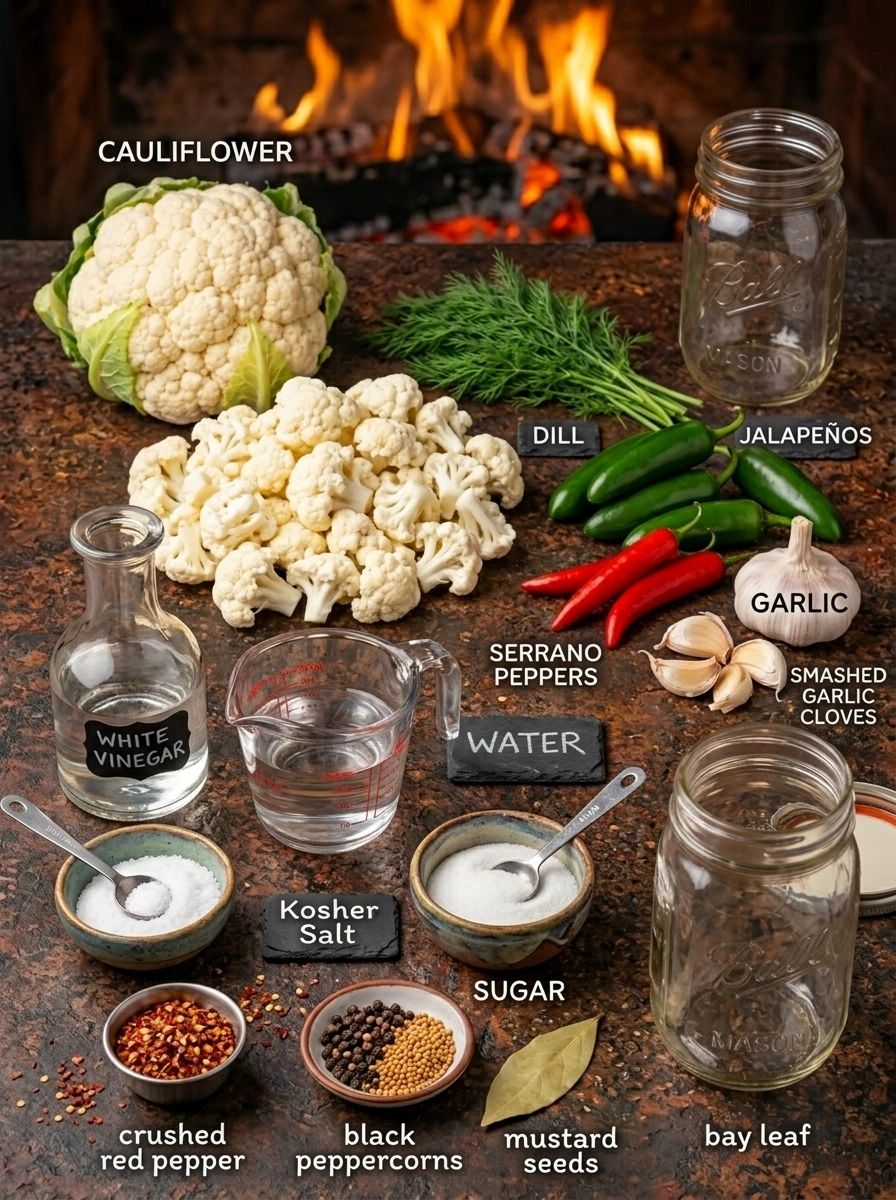
Ingredient Breakdown: What Every Element Contributes
Cauliflower (1 medium head, cut into bite-sized florets)
The star, as discussed above — dense, structurally sound, and an excellent vehicle for bold brine flavors. One medium head typically yields enough florets to fill a quart jar comfortably, with some room for the garlic and peppers tucked throughout.
White Vinegar (1 cup)
The acidic backbone of the brine. White vinegar’s clean, sharp flavor doesn’t compete with the layered heat and herbal notes in this recipe — it provides pure pickling tang and keeps the brine visually clear, which lets the colors of the peppers, garlic, and (if using purple cauliflower) the floret itself show through beautifully.
Water (1 cup)
Balances the vinegar to a level of acidity that’s potent enough to preserve and flavor without being overwhelming. The standard 1:1 ratio used across most quick-pickling recipes.
Pickling Salt or Kosher Salt (1 tbsp)
Seasons the brine and assists with moisture exchange that helps maintain the cauliflower’s firm texture. Always use pickling salt or kosher salt rather than iodized table salt, which can cloud the brine and introduce off flavors.
Sugar (1 tbsp)
A modest amount that balances the sharpness of the vinegar without making the cauliflower taste sweet. It’s a supporting ingredient here — present enough to round the brine’s edges, subtle enough that you won’t identify it as sweetness in the finished pickle.
Garlic (4 cloves, smashed)
Smashed rather than sliced for maximum, rapid flavor release. Smashing ruptures the garlic’s cell walls completely, releasing its aromatic compounds quickly and thoroughly into the hot brine. Four cloves produces a brine — and ultimately, cauliflower — with real, present garlic flavor that complements the heat without being subtle about it.
Jalapeños (2, thinly sliced)
The foundational fresh pepper heat. Bright, green, and vegetal, jalapeños provide a building warmth that most people who enjoy spicy food find immediately satisfying. Thinly sliced for maximum brine infusion and to distribute evenly throughout the jar.
Serrano Pepper (1, optional)
The upgrade for serious heat lovers. Serranos run roughly two to four times hotter than jalapeños, with a sharper, cleaner bite. Including one takes this recipe from “pleasantly spicy” to genuinely firecracker territory — which, given the name, is exactly the point. Leave it out for a milder, still well-spiced result; include it for real heat.
Crushed Red Pepper Flakes (1 tsp)
A different category of heat from the fresh peppers — drier, more concentrated, slower to build. Red pepper flakes infuse into the brine during heating and continue to develop their heat throughout the pickling period, contributing a sustained warmth that complements the brighter, more immediate heat of the jalapeño and serrano.
Black Peppercorns (1 tsp)
Aromatic, warming, and complex without contributing capsaicin heat. Whole peppercorns release their flavor gradually and add a classic spiced depth that’s present in nearly every serious pickling brine for good reason — they round out the overall profile and prevent the heat from feeling one-dimensional.
Mustard Seeds (1 tsp)
A pickling tradition staple. Mustard seeds contribute a mild, earthy bite and a satisfying pop of texture, and after several days in the brine they soften enough to bite into directly, releasing a small burst of warm, tangy flavor.
Dill Seeds (1 tsp, or 2 sprigs fresh dill)
The herbal signature of this recipe. Dill seeds have a more concentrated, slightly more bitter and aromatic flavor than fresh dill fronds — think of them as the more intense, longer-lasting cousin. They infuse the brine with the bright, grassy, slightly anise-like quality that makes pickled vegetables taste unmistakably like pickles. If you have access to fresh dill, two sprigs provide a brighter, fresher herbal note; dill seeds provide a more robust, longer-lasting infusion that holds up particularly well over the full three-week storage window.
Bay Leaf (1)
A quiet, essential background note. One bay leaf adds a faintly floral, herbal complexity to the brine that makes it taste complete and intentional. You won’t identify it directly, but the brine would taste noticeably flatter without it.
How to Make Firecracker Pickled Cauliflower: Step-by-Step
Step 1: Wash and Cut the Cauliflower
Rinse the cauliflower head thoroughly under cold water, paying particular attention to the crevices between florets where dirt and debris can collect. Pat dry with a clean towel. Following the technique described above, cut the head into bite-sized florets, aiming for consistency in size.
Step 2: Pack the Jar
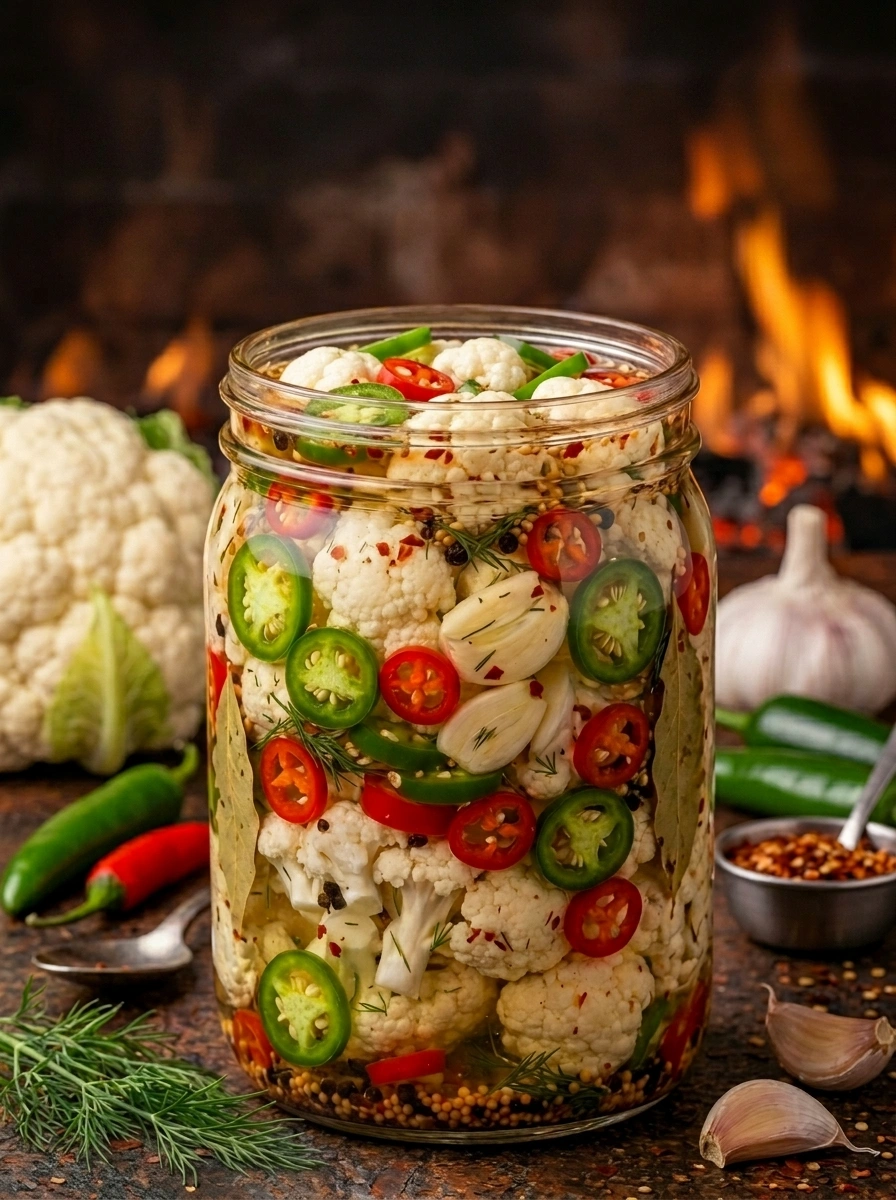
Use a wide-mouth quart jar for the easiest packing and easiest access later. Place the smashed garlic at the bottom of the jar, then begin layering in the cauliflower florets, tucking jalapeño and serrano slices throughout as you go. Pack firmly — cauliflower’s irregular shape means there’s naturally some air space between pieces, and a tightly packed jar helps minimize floating and ensures more even brine contact.
Visual tip: Position a few pepper slices and a garlic clove or two along the visible side of the jar. Once the brine is poured and the jar sits in your fridge, the bright red-orange of the jalapeño and serrano against the white (or purple, if using colored cauliflower) florets makes for a genuinely beautiful presentation.
Step 3: Make the Brine
Combine the white vinegar, water, salt, sugar, crushed red pepper flakes, black peppercorns, mustard seeds, dill seeds, and bay leaf in a small saucepan. Heat over medium heat, stirring occasionally, until the salt and sugar dissolve completely — about 3 to 4 minutes. A gentle simmer is sufficient; you don’t need a rolling boil.
Step 4: Pour the Hot Brine
Carefully pour the hot brine over the packed cauliflower, making sure every floret is fully submerged. Cauliflower’s irregular shape means some pieces may want to float — press them down gently with a clean spoon or, if needed, wedge in a few smaller pieces to weigh things down. Full submersion is essential for even pickling and proper preservation.
Step 5: Cool, Seal, and Refrigerate
Let the jar cool uncovered at room temperature until comfortable to handle, roughly 30 to 45 minutes. Seal tightly and transfer to the refrigerator.
Step 6: The Wait
24 hours: The minimum. The cauliflower has absorbed enough brine to taste distinctly pickled — tangy, lightly spiced, with the beginning of the garlic and heat coming through.
3 to 5 days: The target. By this point, the brine has fully penetrated the dense floret structure, the heat from the jalapeño and serrano has built and integrated, the garlic flavor is pronounced throughout, and the dill has infused its full aromatic character. This is when Firecracker Pickled Cauliflower is at its most exciting.
Beyond 5 days, up to 3 weeks: The flavor continues to deepen and the heat continues to build slightly as capsaicin keeps diffusing through the brine. Many dedicated heat lovers prefer the cauliflower at the two-week mark, when it’s developed its fullest, boldest flavor.
Tips for Maximum Crunch and Flavor
Cut florets a consistent size. Uneven pieces mean uneven pickling — smaller pieces become fully flavored and slightly softer while larger pieces are still developing. Consistency produces the best overall jar.
Don’t skip the blanch if you want extra-tender results. While this recipe is designed for raw cauliflower (which produces maximum crunch), some people prefer a brief 60-second blanch in boiling water followed by an ice bath before pickling. This softens the cauliflower slightly and speeds up brine absorption, at a small cost to crunch. Try both approaches and see which you prefer — raw is more traditional for “firecracker” style pickles and produces the most satisfying snap.
Pack tightly. A loosely packed jar means cauliflower floats and shifts, leading to uneven brine exposure. Pack firmly so the florets stay put once the brine is poured.
Use fresh, firm cauliflower. As with most pickling projects, the quality of your starting vegetable directly determines the quality of your finished pickle. A fresh, dense head produces a crunchier, better-tasting result than one that’s been sitting in the crisper drawer for a week.
Keep everything submerged throughout storage. Any floret poking above the brine line will deteriorate faster and may develop off colors or textures. Check the jar periodically and press down any pieces that have shifted above the liquid.
Every Way to Use Firecracker Pickled Cauliflower
Straight from the jar. The most common fate, and deservedly so. Cold, crunchy, spicy, garlicky — a genuinely satisfying low-calorie snack that requires zero preparation.
On a charcuterie or antipasto board. Firecracker Pickled Cauliflower is a natural addition to any antipasto spread, alongside olives, cured meats, marinated artichokes, and good crusty bread. Its bold flavor and striking appearance make it a standout on any board.
Chopped into a Bloody Mary garnish. Skewer a few florets on a cocktail pick alongside a pickled onion and an olive for a Bloody Mary garnish with genuine character and heat.
On a relish tray. Set out alongside other pickled vegetables — carrots, green beans, pickled onions — for a build-your-own relish tray that’s both visually striking and genuinely interesting to eat, rather than the usual obligatory veggie platter.
Chopped into potato salad or pasta salad. Dice a handful of pickled cauliflower and fold into potato salad or pasta salad for a tangy, spicy crunch that plain raw vegetables can’t replicate.
Alongside a cheese board. The acidity and heat of the pickled cauliflower cuts through rich, creamy cheeses beautifully — try it alongside a soft brie, a sharp aged cheddar, or a tangy goat cheese.
On tacos. Roughly chop a few florets and scatter over fish tacos, carnitas tacos, or crispy chicken tacos for a crunchy, spicy, acidic element that takes the place of standard pickled onions or slaw.
With hot wings or fried chicken. Serve a small bowl alongside hot wings or fried chicken as a cooling, crunchy counterpoint — similar to the way ranch or blue cheese functions, but considerably more interesting.
In a martini. For the adventurous, a single pickled cauliflower floret makes an unexpected and genuinely delicious martini garnish — a savory, spicy twist on the classic pickled vegetable garnish tradition.
Variations to Try
Curry Firecracker: Add 1 teaspoon of curry powder and ½ teaspoon of ground turmeric to the brine for a golden, warmly spiced variation with a completely different but equally delicious flavor profile.
Extra Garlic: Double the garlic to 8 cloves for a version where garlic is the dominant flavor alongside the heat — excellent for garlic lovers and particularly good chopped into pasta dishes.
Bread and Butter Style: Increase the sugar to ¼ cup and add a pinch of celery seed for a sweeter, more approachable cauliflower pickle that balances the heat with real sweetness — great for people who find straight spicy pickles too intense.
Nuclear Heat: Replace the serrano with a habanero, double the red pepper flakes, and add a tablespoon of your favorite hot sauce to the brine. For genuine heat enthusiasts only.
Ranch-Style: Add 1 teaspoon of dried dill, ½ teaspoon of onion powder, and ½ teaspoon of dried chives to the spice mix for a brine that evokes classic ranch flavor alongside the heat — outstanding with hot wings and fried chicken.
Frequently Asked Questions
Why is my pickled cauliflower still hard after several days? This is actually correct and expected. Cauliflower is naturally dense and this recipe is designed to preserve maximum crunch — it should remain quite firm even after a full week in the brine. If you prefer a more tender result, blanch the florets briefly before pickling as described above.
Can I use frozen cauliflower? Fresh is strongly recommended. Frozen cauliflower has already been blanched during processing and has a softer cell structure, which will turn noticeably mushy in the brine rather than maintaining the crisp texture this recipe is built around.
Why did my brine turn cloudy? Some cloudiness from the whole spices and the natural starches in cauliflower is normal and safe. If you notice an off smell along with the cloudiness, discard the batch. Otherwise, mild cloudiness is nothing to worry about.
Can I add other vegetables to the same jar? Absolutely. Carrots, green beans, pearl onions, and bell pepper strips all pickle beautifully alongside cauliflower using this same brine. Just be aware that different vegetables pickle at different rates — denser vegetables like carrots take longer to fully develop flavor than something like bell peppers.
How spicy is this, really? With both jalapeños and a serrano included, this has genuine, noticeable heat — satisfying for people who enjoy spicy food without being extreme. Omitting the serrano and reducing the red pepper flakes produces a much milder, still well-flavored result.
Recipe at a Glance
| Detail | Info |
|---|---|
| Prep Time | 15 minutes |
| Cook Time | 5 minutes |
| Total Time | 20 minutes (plus 24 hours–5 days pickling) |
| Servings | 8 |
| Calories | ~30 per serving |
| Ready to eat | After 24 hours (best at 3–5 days) |
| Storage | Up to 3 weeks refrigerated |
Final Thoughts
Firecracker Pickled Cauliflower proves that the most exciting snacks aren’t always the ones loaded with calories — they’re the ones loaded with flavor. Crunchy, spicy, garlicky, and endlessly snackable, this jar earns its name and then some. Twenty minutes of prep, a few days of patience, and you have something that turns an ordinary vegetable into the most requested item in your refrigerator.
Make a batch. Wait the full five days if you can manage the patience. Try one floret straight from the jar.
You’ll be back for another within the minute.
Print
Firecracker Pickled Cauliflower
- Total Time: 20 minutes (plus 24 hours–5 days pickling)
Ingredients
Cauliflower (1 medium head, cut into bite-sized florets)
The star, as discussed above — dense, structurally sound, and an excellent vehicle for bold brine flavors. One medium head typically yields enough florets to fill a quart jar comfortably, with some room for the garlic and peppers tucked throughout.
White Vinegar (1 cup)
The acidic backbone of the brine. White vinegar’s clean, sharp flavor doesn’t compete with the layered heat and herbal notes in this recipe — it provides pure pickling tang and keeps the brine visually clear, which lets the colors of the peppers, garlic, and (if using purple cauliflower) the floret itself show through beautifully.
Water (1 cup)
Balances the vinegar to a level of acidity that’s potent enough to preserve and flavor without being overwhelming. The standard 1:1 ratio used across most quick-pickling recipes.
Pickling Salt or Kosher Salt (1 tbsp)
Seasons the brine and assists with moisture exchange that helps maintain the cauliflower’s firm texture. Always use pickling salt or kosher salt rather than iodized table salt, which can cloud the brine and introduce off flavors.
Sugar (1 tbsp)
A modest amount that balances the sharpness of the vinegar without making the cauliflower taste sweet. It’s a supporting ingredient here — present enough to round the brine’s edges, subtle enough that you won’t identify it as sweetness in the finished pickle.
Garlic (4 cloves, smashed)
Smashed rather than sliced for maximum, rapid flavor release. Smashing ruptures the garlic’s cell walls completely, releasing its aromatic compounds quickly and thoroughly into the hot brine. Four cloves produces a brine — and ultimately, cauliflower — with real, present garlic flavor that complements the heat without being subtle about it.
Jalapeños (2, thinly sliced)
The foundational fresh pepper heat. Bright, green, and vegetal, jalapeños provide a building warmth that most people who enjoy spicy food find immediately satisfying. Thinly sliced for maximum brine infusion and to distribute evenly throughout the jar.
Serrano Pepper (1, optional)
The upgrade for serious heat lovers. Serranos run roughly two to four times hotter than jalapeños, with a sharper, cleaner bite. Including one takes this recipe from “pleasantly spicy” to genuinely firecracker territory — which, given the name, is exactly the point. Leave it out for a milder, still well-spiced result; include it for real heat.
Crushed Red Pepper Flakes (1 tsp)
A different category of heat from the fresh peppers — drier, more concentrated, slower to build. Red pepper flakes infuse into the brine during heating and continue to develop their heat throughout the pickling period, contributing a sustained warmth that complements the brighter, more immediate heat of the jalapeño and serrano.
Black Peppercorns (1 tsp)
Aromatic, warming, and complex without contributing capsaicin heat. Whole peppercorns release their flavor gradually and add a classic spiced depth that’s present in nearly every serious pickling brine for good reason — they round out the overall profile and prevent the heat from feeling one-dimensional.
Mustard Seeds (1 tsp)
A pickling tradition staple. Mustard seeds contribute a mild, earthy bite and a satisfying pop of texture, and after several days in the brine they soften enough to bite into directly, releasing a small burst of warm, tangy flavor.
Dill Seeds (1 tsp, or 2 sprigs fresh dill)
The herbal signature of this recipe. Dill seeds have a more concentrated, slightly more bitter and aromatic flavor than fresh dill fronds — think of them as the more intense, longer-lasting cousin. They infuse the brine with the bright, grassy, slightly anise-like quality that makes pickled vegetables taste unmistakably like pickles. If you have access to fresh dill, two sprigs provide a brighter, fresher herbal note; dill seeds provide a more robust, longer-lasting infusion that holds up particularly well over the full three-week storage window.
Bay Leaf (1)
A quiet, essential background note. One bay leaf adds a faintly floral, herbal complexity to the brine that makes it taste complete and intentional. You won’t identify it directly, but the brine would taste noticeably flatter without it.
Instructions
Step 1: Wash and Cut the Cauliflower
Rinse the cauliflower head thoroughly under cold water, paying particular attention to the crevices between florets where dirt and debris can collect. Pat dry with a clean towel. Following the technique described above, cut the head into bite-sized florets, aiming for consistency in size.
Step 2: Pack the Jar
Use a wide-mouth quart jar for the easiest packing and easiest access later. Place the smashed garlic at the bottom of the jar, then begin layering in the cauliflower florets, tucking jalapeño and serrano slices throughout as you go. Pack firmly — cauliflower’s irregular shape means there’s naturally some air space between pieces, and a tightly packed jar helps minimize floating and ensures more even brine contact.
Visual tip: Position a few pepper slices and a garlic clove or two along the visible side of the jar. Once the brine is poured and the jar sits in your fridge, the bright red-orange of the jalapeño and serrano against the white (or purple, if using colored cauliflower) florets makes for a genuinely beautiful presentation.
Step 3: Make the Brine
Combine the white vinegar, water, salt, sugar, crushed red pepper flakes, black peppercorns, mustard seeds, dill seeds, and bay leaf in a small saucepan. Heat over medium heat, stirring occasionally, until the salt and sugar dissolve completely — about 3 to 4 minutes. A gentle simmer is sufficient; you don’t need a rolling boil.
Step 4: Pour the Hot Brine
Carefully pour the hot brine over the packed cauliflower, making sure every floret is fully submerged. Cauliflower’s irregular shape means some pieces may want to float — press them down gently with a clean spoon or, if needed, wedge in a few smaller pieces to weigh things down. Full submersion is essential for even pickling and proper preservation.
Step 5: Cool, Seal, and Refrigerate
Let the jar cool uncovered at room temperature until comfortable to handle, roughly 30 to 45 minutes. Seal tightly and transfer to the refrigerator.
Step 6: The Wait
24 hours: The minimum. The cauliflower has absorbed enough brine to taste distinctly pickled — tangy, lightly spiced, with the beginning of the garlic and heat coming through.
3 to 5 days: The target. By this point, the brine has fully penetrated the dense floret structure, the heat from the jalapeño and serrano has built and integrated, the garlic flavor is pronounced throughout, and the dill has infused its full aromatic character. This is when Firecracker Pickled Cauliflower is at its most exciting.
Beyond 5 days, up to 3 weeks: The flavor continues to deepen and the heat continues to build slightly as capsaicin keeps diffusing through the brine. Many dedicated heat lovers prefer the cauliflower at the two-week mark, when it’s developed its fullest, boldest flavor.
- Prep Time: 15 minutes
- Cook Time: 5 minutes
Nutrition
- Serving Size: 8
- Calories: 30 per serving