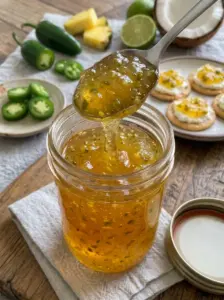
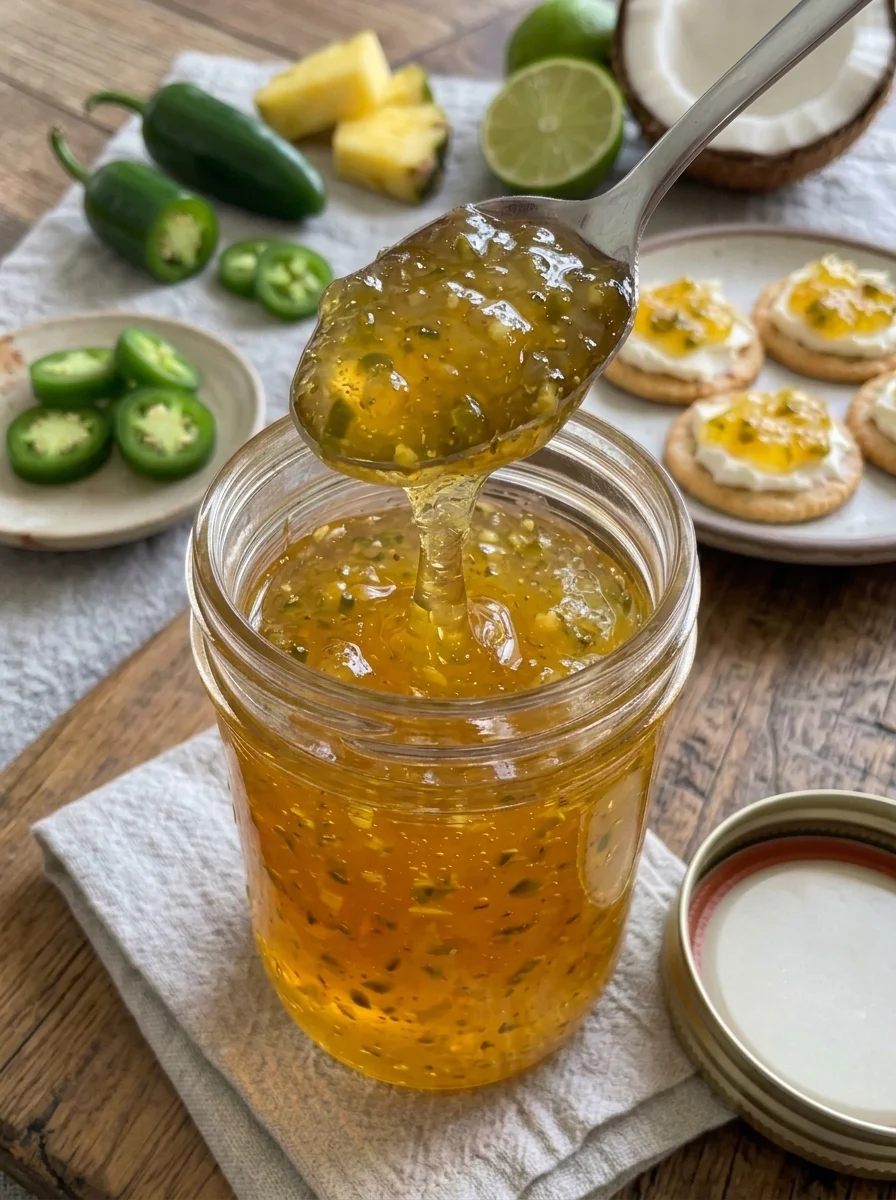
Sweet, tropical, tangy, and finished with a gentle chile kick, this Piña Colada Jalapeño Jelly combines juicy pineapple, creamy coconut flavor, fresh lime, and jalapeños in one glossy sweet-and-spicy spread.
It takes the familiar idea of pepper jelly and gives it a tropical piña colada-inspired twist. Pineapple juice and crushed pineapple create the fruity base, coconut milk and coconut extract bring the island-inspired flavor, fresh lime adds brightness, and finely minced jalapeños balance all that sweetness with a little heat.
Serve it spooned over cream cheese with crackers, brush it over grilled chicken or shrimp, pair it with appetizers, or use it as a tropical sweet-and-spicy glaze.
Because this recipe contains coconut milk, this version is intended for refrigerator or freezer storage rather than pantry storage.
Why You’ll Love Piña Colada Jalapeño Jelly
Sweet and spicy. Pineapple and sugar balance the fresh jalapeño heat.
Tropical flavor. Pineapple, coconut, and lime create the classic piña colada-inspired combination.
Easy appetizer. Spoon it over a block of cream cheese and add crackers.
Adjustable heat. Remove the jalapeño seeds and membranes for a milder jelly or retain some for extra heat.
Beautiful glossy texture. Liquid pectin helps transform the fruit mixture into a spoonable jelly-style spread.
Versatile. Use it with cheese, crackers, grilled meats, seafood, sandwiches, or appetizers.
Party-friendly. Its bright tropical flavor makes it especially fun for summer gatherings, cookouts, and appetizer boards.
Freezer-friendly. Freeze portions for longer storage rather than attempting untested shelf-stable canning.
What Is Piña Colada Jalapeño Jelly?
Piña Colada Jalapeño Jelly is a tropical variation on sweet pepper jelly.
Traditional pepper jelly commonly combines peppers, sugar, acidity, and pectin.
This version introduces three flavors associated with a piña colada:
Pineapple + coconut + lime.
Jalapeños then provide a contrasting savory heat.
The result isn’t meant to taste like an extremely hot pepper sauce.
Instead, it starts sweet and fruity, followed by coconut and lime, with jalapeño warmth developing in the background.
That sweet-heat combination makes it particularly good with creamy, salty, and savory foods.
Ingredients
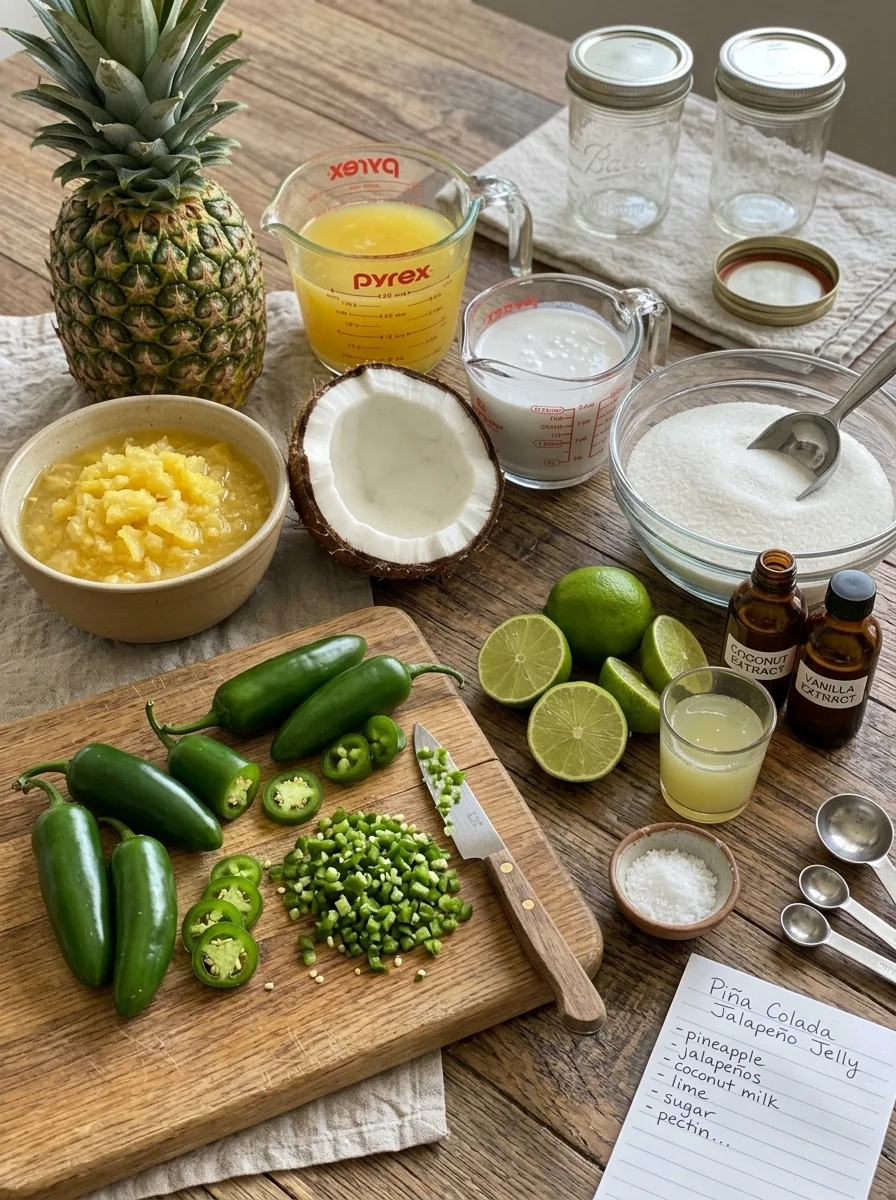
- 2 cups pineapple juice
- 1 cup crushed pineapple, very well drained
- 1/2 cup finely minced jalapeños, seeds removed for milder heat
- 1/4 cup finely minced jalapeños, seeds included for more heat
- 1/4 cup fresh lime juice
- 1/2 cup unsweetened coconut milk
- 4 1/2 cups granulated sugar
- 1 pouch (3 oz) liquid pectin
- 1/4 tsp salt
- 1/2 tsp coconut extract
- 1/2 tsp vanilla extract
Ingredient Notes
Pineapple Juice 🍍
Pineapple juice creates the main fruity liquid base.
Its sweet-tart flavor pairs naturally with both coconut and chile peppers.
Crushed Pineapple
Crushed pineapple gives the finished spread more fruit texture than pineapple juice alone.
Drain it very well before measuring.
Excess liquid can affect the consistency of the finished jelly.
Jalapeños 🌶️
Fresh jalapeños provide the pepper flavor and heat.
The recipe uses both seeded and seed-containing portions so you get noticeable jalapeño character without necessarily making the jelly overwhelmingly spicy.
Heat can vary significantly from one jalapeño to another.
Always taste and adjust carefully.
Fresh Lime Juice 🍋🟩
Lime cuts through the sweetness of the pineapple, coconut, and sugar.
It also reinforces the tropical flavor profile.
Unsweetened Coconut Milk 🥥
Coconut milk gives this jelly its distinctive piña colada character and subtle creaminess.
Use unsweetened coconut milk rather than sweetened cream of coconut.
They’re different products and aren’t interchangeable here.
Granulated Sugar
This recipe contains a substantial amount of sugar because sugar contributes not only sweetness but also interacts with the pectin and liquid mixture to influence the final set.
Don’t dramatically reduce the sugar while expecting the same texture.
Liquid Pectin
A 3-ounce pouch of liquid pectin helps the cooked mixture thicken as it cools.
Follow the recipe sequence carefully.
The pectin goes in after the fruit and sugar mixture reaches a full rolling boil.
Salt
A small amount of salt helps balance the sweetness and sharpen the pineapple, coconut, and pepper flavors.
Coconut Extract
Coconut milk alone can produce a relatively subtle coconut flavor.
Coconut extract strengthens that flavor without adding much more liquid.
Vanilla Extract
Vanilla rounds out the pineapple and coconut and gives the jelly a slightly dessert-like tropical aroma.
How to Make Piña Colada Jalapeño Jelly
Step 1: Prepare the Jalapeños
Wear food-safe gloves while handling the peppers.
Remove the stems.
For the milder portion, remove the seeds and pale interior membranes before finely mincing the peppers.
For additional heat, leave some seeds and membranes in the remaining jalapeños.
Finely mince enough peppers to make:
- 1/2 cup seeded jalapeños
- 1/4 cup hotter jalapeños with some seeds retained
Keep the pieces small so they’re distributed throughout the finished jelly.
Important Jalapeño Handling Tip
Capsaicin—the compound responsible for chile heat—can remain on your hands.
Avoid touching your eyes, nose, or face while preparing the peppers.
Gloves are strongly recommended.
Wash your hands, knife, cutting board, and other equipment thoroughly afterward.
Step 2: Drain the Crushed Pineapple
Measure the crushed pineapple after draining it thoroughly.
Press away excess juice if necessary.
You want 1 cup well-drained crushed pineapple.
This gives the jelly pineapple texture without introducing unnecessary extra liquid.
Step 3: Combine the Tropical Fruit Mixture 🍍🥥
Choose a large, deep saucepan.
Add:
- 2 cups pineapple juice
- 1 cup well-drained crushed pineapple
- 1/2 cup seeded minced jalapeños
- 1/4 cup minced jalapeños with some seeds
- 1/4 cup fresh lime juice
- 1/2 cup unsweetened coconut milk
- 1/4 teaspoon salt
Stir thoroughly.
Why Use a Large Saucepan?
Jelly mixtures can rise considerably once they reach a vigorous boil.
Using a saucepan that seems much larger than the initial volume gives the bubbling mixture room to expand and makes stirring safer.
Avoid using a pan that’s filled close to the top.
Step 4: Add the Sugar
Add 4 1/2 cups granulated sugar.
Stir until the sugar is evenly incorporated throughout the pineapple mixture.
Step 5: Bring to a Full Rolling Boil
Place the saucepan over medium-high heat.
Cook while stirring frequently.
Bring the mixture to a full rolling boil.
A full rolling boil means the mixture continues bubbling vigorously even while you’re stirring it.
Don’t begin the final pectin timing while the mixture is only gently simmering.
Step 6: Add the Liquid Pectin
Once you’ve reached the rolling boil, pour in the entire 3-ounce pouch of liquid pectin.
Stir constantly.
Step 7: Return to a Hard Boil
Continue heating until the mixture returns to a full rolling boil.
Once it does, boil hard for approximately 1 minute, stirring constantly.
Watch the pan carefully because the mixture will be extremely hot and can bubble vigorously.
Step 8: Remove from the Heat
After the hard-boil period, remove the saucepan from the burner.
Don’t continue cooking unnecessarily.
Step 9: Add the Coconut and Vanilla Extracts
Stir in:
- 1/2 teaspoon coconut extract
- 1/2 teaspoon vanilla extract
Adding the extracts after removing the saucepan from direct heat helps preserve more of their aromatic character.
Step 10: Remove Excess Foam
If foam has accumulated across the surface, skim it away carefully with a clean spoon.
A little foam won’t ruin the jelly, but removing it can create a cleaner-looking finished product.
Step 11: Transfer to Clean Containers
Carefully ladle the hot jelly mixture into clean, heat-safe containers suitable for refrigerated storage.
Leave enough room at the top, especially if you plan to freeze some of the jelly later.
Avoid thermal shock by making sure your containers are appropriate for hot contents.
Step 12: Let the Jelly Cool
Allow the containers to cool before covering and refrigerating according to safe food-handling practices.
The jelly will continue thickening as it cools.
Don’t judge the final consistency while it’s still hot.
Step 13: Refrigerate
Once cooled, cover tightly and refrigerate.
For the best texture, allow the jelly plenty of time to chill and set before serving.
Recipe Information ⏱️
Prep Time: 15 minutes
Cook Time: approximately 10 minutes
Active Total Time: approximately 25 minutes
Additional Time: cooling and chilling
Yield: approximately 5 cups
Estimated Calories: approximately 55 calories per tablespoon
The calorie figure is an estimate. Exact nutrition depends on the final yield, serving size, pineapple products, coconut milk, and other ingredients used.
What Does Piña Colada Jalapeño Jelly Taste Like?
The flavor develops in layers.
First comes the sweet pineapple.
Next you’ll notice creamy coconut and bright lime.
Then the jalapeño arrives with fresh green-pepper flavor and a warming chile finish.
Vanilla subtly rounds everything out without making the jelly taste like vanilla pudding or cake.
The goal is:
Sweet + tropical + tangy + gently spicy.
The jalapeño shouldn’t completely overpower the pineapple and coconut.
How Spicy Is This Jalapeño Jelly?
The heat level depends heavily on your peppers.
Jalapeños naturally vary in heat.
Removing the pale membranes and seeds from most of the peppers generally produces a milder result.
Keeping more membrane and seeds increases the likelihood of a hotter batch.
The sugar and pineapple also soften the perception of heat.
For a broad party audience, keeping most of the jalapeños seeded is usually the safer approach.
How to Make It Milder 🌶️
Remove the seeds and pale membranes from all of the jalapeños.
You can also reduce the amount of jalapeño slightly if your peppers are particularly hot.
Keep in mind that reducing the peppers also reduces the fresh pepper flavor.
How to Make It Hotter 🔥
Keep more of the membranes and seeds.
You can also select hotter jalapeños.
Increase heat carefully, especially if you’re serving a group.
The tropical pineapple-coconut flavor should still be noticeable.
Why Add Coconut Extract?
Coconut milk gives the jelly body and coconut flavor, but its flavor can become subtle when combined with pineapple, lime, jalapeño, and a large amount of sugar.
A small amount of coconut extract reinforces the tropical character.
Use it sparingly.
Too much coconut extract can overwhelm the pineapple and make the flavor seem artificial.
Why Add Vanilla?
Vanilla is a supporting flavor.
It softens the edges of the pineapple and coconut and makes the tropical flavors seem slightly rounder.
Only 1/2 teaspoon is needed.
Why Isn’t My Jelly Thick While It’s Hot?
That’s normal.
Hot jelly is significantly more fluid than cooled jelly.
Pectin-based mixtures continue developing their final consistency as they cool.
Allow the jelly to cool completely and chill before deciding whether it has properly set.
Tips for the Best Piña Colada Jalapeño Jelly
Drain the pineapple thoroughly. Excess liquid can affect consistency.
Finely mince the jalapeños. Smaller pieces distribute more evenly.
Wear gloves. Jalapeño oils can irritate skin and eyes.
Use unsweetened coconut milk. Don’t accidentally substitute cream of coconut.
Use a deep saucepan. The mixture expands dramatically while boiling.
Reach a genuine rolling boil. Gentle simmering isn’t the same thing.
Add the liquid pectin at the correct stage. Follow the recipe sequence.
Stir constantly during the hard boil. This helps prevent scorching.
Add extracts off the heat. Their flavors remain fresher.
Don’t judge the texture while hot. Let the jelly cool completely.
Refrigerate this version. Don’t treat it as a shelf-stable canned jelly.
The Important Difference Between Coconut Milk and Cream of Coconut
These products sound similar but are very different.
Unsweetened coconut milk is used in this recipe.
Cream of coconut is generally much sweeter and thicker and is commonly used in cocktails and desserts.
Replacing coconut milk with cream of coconut would substantially change the sugar level, consistency, and overall formula.
For predictable results, use the ingredient specified.
Best Way to Serve Piña Colada Jalapeño Jelly
Over Cream Cheese 🧀
This is probably the easiest appetizer.
Place a block of softened cream cheese on a serving plate.
Spoon the chilled jalapeño jelly generously over the top.
Serve with crackers.
The cool, creamy cheese balances the sweet chile heat beautifully.
With Goat Cheese
Tangy goat cheese provides another excellent contrast to the pineapple and coconut sweetness.
With Brie
Serve a small amount alongside creamy Brie and crackers.
Grilled Chicken 🍗
Brush a thin layer over cooked or nearly finished grilled chicken.
Because the jelly contains lots of sugar, avoid applying a thick coating over intense direct heat for too long—it can burn.
Grilled Shrimp 🍤
Pineapple, coconut, lime, chile, and shrimp are a natural combination.
Use the jelly as a finishing glaze rather than exposing it to prolonged high heat.
Appetizer Meatballs
Warm a little jelly and use it as part of a sweet-and-spicy glaze for cocktail meatballs.
Crackers
Serve it as part of a cheese-and-cracker board.
Sandwiches
A thin layer can add sweetness and heat to savory chicken, turkey, or ham sandwiches.
Charcuterie Boards
Pair it with cheeses, crackers, nuts, cured meats, and fresh fruit.
Piña Colada Jalapeño Jelly Cream Cheese Appetizer
For an incredibly simple party appetizer:
Place 8 ounces of cream cheese on a serving plate.
Allow it to soften slightly.
Spoon several tablespoons of chilled Piña Colada Jalapeño Jelly over the top.
Garnish with a tiny amount of finely diced fresh pineapple or jalapeño if desired.
Serve immediately with sturdy crackers.
You get creamy, salty, sweet, fruity, and spicy flavors in one bite.
Using It as a Glaze
This jelly can also become an easy finishing glaze.
Warm a small amount just until it becomes more fluid.
Brush it over cooked:
- Chicken
- Shrimp
- Pork
- Meatballs
- Grilled appetizers
Because of the high sugar content, use care around very high heat.
Sugar can caramelize quickly and eventually burn.
For grilling, it’s generally better to add sweet glazes near the end of cooking.
Easy Variations
Mild Piña Colada Pepper Jelly
Remove the seeds and membranes from all the jalapeños.
You’ll retain the fresh pepper flavor with less heat.
Extra-Spicy Tropical Jelly 🔥
Keep more of the jalapeño membranes and seeds.
Extra-Lime Piña Colada Jelly 🍋🟩
For stronger lime aroma, add a little finely grated lime zest rather than substantially increasing the amount of liquid.
Pineapple-Forward Jelly 🍍
Emphasize the pineapple by keeping the coconut extract subtle.
Coconut-Forward Jelly 🥥
Slightly increase the coconut extract, but do so very cautiously because extracts are concentrated.
Chunkier Pineapple Pepper Spread
Leave the crushed pineapple slightly more textured.
This moves the finished product toward a jam-like spread rather than a completely smooth jelly.
Refrigerator Storage 🫙
Because this recipe contains coconut milk, the recipe as written should be treated as a refrigerated product, not as a shelf-stable home-canned jelly.
Transfer the finished mixture to clean containers.
Once cooled appropriately, cover and refrigerate.
For best quality, use within approximately 2–3 weeks.
Always use a clean utensil when removing jelly from the container.
If you notice mold, an unexpected unpleasant odor, unusual fermentation, or other obvious signs of spoilage, discard the batch.
Important Canning Safety Note
Do not assume that ordinary pepper-jelly water-bath instructions can be applied to this recipe.
The addition of coconut milk changes the formula.
This recipe has not been presented as a tested shelf-stable home-canning formula, so you should not improvise a processing time or assume that boiling filled jars will make it safe for pantry storage.
If you want a shelf-stable version, use a specifically tested home-canning recipe from a reliable food-preservation authority and follow its ingredients, proportions, jar size, processing method, altitude adjustment, and processing time exactly.
Do not simply add coconut milk to an otherwise tested pepper-jelly recipe.
Can I Water-Bath Can This Recipe?
Not as written based solely on these instructions.
Treat this version as a refrigerator/freezer jelly.
A safe shelf-stable canning process requires more than simply choosing a processing time.
The complete formulation and process need to be appropriate for home canning.
Can I Leave It at Room Temperature?
Not for storage.
This version should remain refrigerated after cooling.
When serving it at a party, put out the amount you expect to use and keep the remainder refrigerated.
Can You Freeze Piña Colada Jalapeño Jelly?
Yes.
Freezing is a practical option when you want to keep it longer than the refrigerator-storage period.
Transfer the cooled jelly to freezer-safe containers, leaving adequate room for expansion.
Freeze for up to approximately 3 months for best quality.
Thaw overnight in the refrigerator.
Stir gently before serving if the texture has separated slightly.
Can I Freeze It in Small Portions?
Absolutely.
Small freezer-safe containers are particularly convenient.
Divide the cooled jelly into portions based on how much you normally use.
That way, you don’t need to thaw an entire large batch whenever you want an appetizer.
Troubleshooting
Why didn’t my jelly set?
Several things can affect pectin-based jelly:
- Incorrect pectin quantity
- Incorrect sugar quantity
- Failure to reach a true rolling boil
- Insufficient boiling after adding pectin
- Excess liquid from poorly drained pineapple
- Ingredient substitutions
- Judging the texture before the jelly has fully cooled
Allow it to cool completely before concluding that it hasn’t set.
Why is my jelly too firm?
Overcooking or changing the ingredient ratios can contribute to an overly firm set.
Follow the timing carefully once the pectin has been added.
Why is my jelly too runny?
Make sure the crushed pineapple was thoroughly drained and that you reached a genuine rolling boil.
Also give the jelly adequate cooling and chilling time.
Why did the coconut milk separate?
Coconut milk naturally contains fat and water and can sometimes separate.
Stir it thoroughly before measuring.
Some slight appearance or texture variation can also occur after cooling or freezing.
Why is my jelly too sweet?
Pepper jelly is intentionally sweet, and the sugar also contributes to the pectin system.
Rather than dramatically reducing the sugar in this formula, serve the jelly with salty, tangy, or spicy foods that balance its sweetness.
Why isn’t it spicy enough?
Jalapeño heat varies naturally.
Use more of the membrane and seeds in a future batch if you want stronger heat.
Why is it too spicy?
Serve it with cream cheese or another creamy cheese.
The sweetness and dairy help balance the heat.
For your next batch, remove more of the jalapeño membranes and seeds.
Why doesn’t it taste enough like coconut?
Make sure you’re using fresh coconut extract.
You can adjust the extract slightly in a future batch, but add it carefully because concentrated coconut flavor can quickly become overpowering.
Frequently Asked Questions
What is Piña Colada Jalapeño Jelly?
It’s a tropical sweet-and-spicy pepper jelly-style spread flavored with pineapple, coconut, lime, and fresh jalapeños.
Is it very spicy?
It doesn’t have to be. Removing most of the jalapeño seeds and membranes produces a milder version.
Can I make it hotter?
Yes. Retain more of the jalapeño membranes and seeds.
Does it contain alcohol?
No. The piña colada name refers to the pineapple-coconut flavor combination in this recipe; no rum is included.
What kind of coconut milk should I use?
Use unsweetened coconut milk.
Can I use cream of coconut?
Not as a direct substitute. Cream of coconut is much sweeter and will change the recipe.
Why do I need liquid pectin?
Pectin helps the fruit mixture develop its jelly-like consistency as it cools.
Can I reduce the sugar?
Significantly changing the sugar can change the finished set. For predictable results, don’t substantially alter the sugar while expecting the same consistency.
What is a full rolling boil?
It’s a vigorous boil that continues bubbling even while the mixture is being stirred.
When do I add the pectin?
Add it after the fruit-and-sugar mixture reaches a full rolling boil.
When do I add the coconut and vanilla extracts?
After removing the cooked jelly from direct heat.
What is the easiest way to serve it?
Spoon it over softened cream cheese and serve with crackers.
Is it good with chicken?
Yes. It works particularly well as a finishing glaze for grilled chicken.
Is it good with shrimp?
Yes. Pineapple, coconut, lime, jalapeño, and shrimp pair especially well.
Can I water-bath can this exact recipe?
Don’t treat this recipe as a shelf-stable canning formula. The coconut milk makes it unsuitable for simply borrowing processing instructions from an ordinary pepper jelly recipe.
Does it need refrigeration?
Yes, this version should be refrigerated.
How long does it keep?
For best quality, use the refrigerated jelly within approximately 2–3 weeks.
Can I freeze it?
Yes. Freeze it in appropriate containers for up to approximately 3 months for best quality.
Final Thoughts
This Piña Colada Jalapeño Jelly turns classic sweet pepper jelly into a tropical party spread packed with pineapple, coconut, lime, and fresh jalapeño flavor.
The pineapple brings juicy sweetness, coconut creates the unmistakable piña colada-inspired character, lime keeps everything bright, and jalapeños provide just enough heat to keep the jelly from tasting like an ordinary fruit spread.
For an effortless appetizer, spoon it over cream cheese and serve with crackers. For dinner, try it as a finishing glaze on grilled chicken, shrimp, pork, or meatballs.
Just remember the important storage distinction: because this formulation contains coconut milk, keep this version refrigerated or freeze it for longer storage. Don’t treat it as a shelf-stable canned pepper jelly unless you’re following a separately tested home-canning formulation specifically designed for that purpose.
Sweet, tangy, tropical, and spicy all at once, it’s an easy way to bring a little unexpected island flavor to your next appetizer board or cookout.
Print
Piña Colada Jalapeño Jelly
- Total Time: approximately 25 minutes
- Yield: 5 cups 1x
Ingredients
- 2 cups pineapple juice
- 1 cup crushed pineapple, very well drained
- 1/2 cup finely minced jalapeños, seeds removed for milder heat
- 1/4 cup finely minced jalapeños, seeds included for more heat
- 1/4 cup fresh lime juice
- 1/2 cup unsweetened coconut milk
- 4 1/2 cups granulated sugar
- 1 pouch (3 oz) liquid pectin
- 1/4 tsp salt
- 1/2 tsp coconut extract
- 1/2 tsp vanilla extract
Instructions
Step 1: Prepare the Jalapeños
Wear food-safe gloves while handling the peppers.
Remove the stems.
For the milder portion, remove the seeds and pale interior membranes before finely mincing the peppers.
For additional heat, leave some seeds and membranes in the remaining jalapeños.
Finely mince enough peppers to make:
- 1/2 cup seeded jalapeños
- 1/4 cup hotter jalapeños with some seeds retained
Keep the pieces small so they’re distributed throughout the finished jelly.
Important Jalapeño Handling Tip
Capsaicin—the compound responsible for chile heat—can remain on your hands.
Avoid touching your eyes, nose, or face while preparing the peppers.
Gloves are strongly recommended.
Wash your hands, knife, cutting board, and other equipment thoroughly afterward.
Step 2: Drain the Crushed Pineapple
Measure the crushed pineapple after draining it thoroughly.
Press away excess juice if necessary.
You want 1 cup well-drained crushed pineapple.
This gives the jelly pineapple texture without introducing unnecessary extra liquid.
Step 3: Combine the Tropical Fruit Mixture 🍍🥥
Choose a large, deep saucepan.
Add:
- 2 cups pineapple juice
- 1 cup well-drained crushed pineapple
- 1/2 cup seeded minced jalapeños
- 1/4 cup minced jalapeños with some seeds
- 1/4 cup fresh lime juice
- 1/2 cup unsweetened coconut milk
- 1/4 teaspoon salt
Stir thoroughly.
Why Use a Large Saucepan?
Jelly mixtures can rise considerably once they reach a vigorous boil.
Using a saucepan that seems much larger than the initial volume gives the bubbling mixture room to expand and makes stirring safer.
Avoid using a pan that’s filled close to the top.
Step 4: Add the Sugar
Add 4 1/2 cups granulated sugar.
Stir until the sugar is evenly incorporated throughout the pineapple mixture.
Step 5: Bring to a Full Rolling Boil
Place the saucepan over medium-high heat.
Cook while stirring frequently.
Bring the mixture to a full rolling boil.
A full rolling boil means the mixture continues bubbling vigorously even while you’re stirring it.
Don’t begin the final pectin timing while the mixture is only gently simmering.
Step 6: Add the Liquid Pectin
Once you’ve reached the rolling boil, pour in the entire 3-ounce pouch of liquid pectin.
Stir constantly.
Step 7: Return to a Hard Boil
Continue heating until the mixture returns to a full rolling boil.
Once it does, boil hard for approximately 1 minute, stirring constantly.
Watch the pan carefully because the mixture will be extremely hot and can bubble vigorously.
Step 8: Remove from the Heat
After the hard-boil period, remove the saucepan from the burner.
Don’t continue cooking unnecessarily.
Step 9: Add the Coconut and Vanilla Extracts
Stir in:
- 1/2 teaspoon coconut extract
- 1/2 teaspoon vanilla extract
Adding the extracts after removing the saucepan from direct heat helps preserve more of their aromatic character.
Step 10: Remove Excess Foam
If foam has accumulated across the surface, skim it away carefully with a clean spoon.
A little foam won’t ruin the jelly, but removing it can create a cleaner-looking finished product.
Step 11: Transfer to Clean Containers
Carefully ladle the hot jelly mixture into clean, heat-safe containers suitable for refrigerated storage.
Leave enough room at the top, especially if you plan to freeze some of the jelly later.
Avoid thermal shock by making sure your containers are appropriate for hot contents.
Step 12: Let the Jelly Cool
Allow the containers to cool before covering and refrigerating according to safe food-handling practices.
The jelly will continue thickening as it cools.
Don’t judge the final consistency while it’s still hot.
Step 13: Refrigerate
Once cooled, cover tightly and refrigerate.
For the best texture, allow the jelly plenty of time to chill and set before serving.
- Prep Time: 15 minutes
- Cook Time: approximately 10 minutes
Nutrition
- Calories: approximately 55 calories per tablespoon