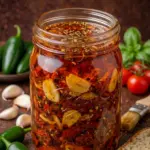
Ingredients
Extra Virgin Olive Oil (1 cup)
The foundation of everything. A full cup of extra virgin olive oil isn’t just a cooking medium here — it’s the primary ingredient, the canvas on which every other flavor is painted. The quality of the oil matters significantly. Extra virgin olive oil is the highest grade, cold-pressed from olives without chemical treatment, and it retains the fullest flavor and the most beneficial compounds. A good extra virgin olive oil has its own flavor — grassy, peppery, sometimes fruity — which becomes part of the finished condiment.
Don’t substitute light olive oil or vegetable oil. The neutral flavor of refined oils produces a thinner, less interesting result. The richness and character of extra virgin olive oil is what makes this condiment so luxurious.
One practical note: extra virgin olive oil solidifies in the refrigerator. This is completely normal — it’s a sign of quality. A jar stored in the fridge will turn opaque and semi-solid when cold. Let it come to room temperature for 15 to 20 minutes before serving and it will return to its liquid, pourable state.
Garlic (8 cloves, thinly sliced)
Eight cloves of garlic is not a typo. It’s the entire point. Thinly sliced rather than minced because slices release their flavor more gradually into the oil, producing a sweeter, more nuanced garlic infusion rather than the sharp, pungent hit of crushed or minced garlic. As the garlic cooks slowly in the oil, it softens, sweetens, and turns from raw and aggressive to something mellow, golden, and deeply savory. The slices themselves become tender and flavorful — little pieces of garlic confit suspended in the oil that you’ll find yourself specifically seeking out with your bread.
Sun-Dried Tomatoes (½ cup, finely chopped)
Sun-dried tomatoes are the concentrated soul of this recipe. Fresh tomatoes are mostly water — they’re mild and bright, but their flavor is diffuse. Sun-dried tomatoes have had virtually all of that water removed, which concentrates their flavor to an extraordinary intensity. What you get is something almost meaty in richness: deeply sweet, slightly acidic, with an umami depth that fresh tomatoes can’t approach. Finely chopped, they distribute throughout the oil and cook down further during the simmering step, releasing even more of their concentrated flavor into the base.
Use oil-packed sun-dried tomatoes rather than dry ones if possible. Oil-packed tomatoes are already softened and more flavorful, and they blend more seamlessly into the oil.
Tomato Paste (1 tbsp)
Tomato paste is the most concentrated form of tomato flavor available in a jar, and a single tablespoon makes a dramatic difference. It adds depth, color, and an almost savory-sweet richness that amplifies the sun-dried tomatoes and ties the whole composition together. When it’s stirred into hot oil with the sun-dried tomatoes, it blooms and darkens slightly, developing an even deeper, more complex flavor through a process similar to caramelization.
Crushed Red Pepper Flakes (1 tsp, or more to taste)
The heat that makes this oil genuinely spicy rather than just flavorful. One teaspoon delivers a consistent, building warmth that sits comfortably in the background of every bite. More than that and the heat becomes a foreground element — excellent if that’s what you’re after. The fat-soluble capsaicin in the red pepper dissolves completely into the olive oil during the simmer, which means the heat is distributed absolutely evenly throughout the finished condiment rather than concentrated in individual flakes.
Italian Seasoning (1 tsp) and Dried Oregano (½ tsp)
Together these form the herbal backbone of the recipe. Italian seasoning is a blend of dried basil, thyme, rosemary, marjoram, and sometimes sage — a combination that evokes the aromatic herb gardens of the Italian countryside. The additional dried oregano reinforces the Mediterranean character and adds a slightly more assertive, earthy herbal note that fresh oregano alone doesn’t provide. Both are added to the hot oil during the simmering step, which blooms their volatile oils and extracts maximum flavor.
Smoked Paprika (½ tsp)
A quiet but crucial ingredient. Smoked paprika contributes warmth, a faint smokiness, and a gorgeous deep red color that gives the finished oil its rich, burnished appearance. It complements the concentrated tomato flavor and adds a dimension of depth that makes the oil taste more complex than a simple ingredient list might suggest.
Fresh Basil or Parsley (1 tbsp, chopped)
Added off heat at the very end, fresh herbs contribute brightness and color that dried herbs can’t provide. The heat of the oil wilts them gently without destroying their fresh flavor, and they add an aromatic lift that keeps the finished condiment from tasting entirely cooked. Basil leans the flavor profile more Italian and floral; parsley adds a cleaner, more neutral herbal brightness. Both are excellent — choose based on what you have and what you’re serving the oil with.
Lemon Juice (1 tsp)
The finishing acid. A single teaspoon of lemon juice, added off heat alongside the fresh herbs, brightens the entire composition and prevents the oil from tasting heavy or flat. It’s the same principle as adding a squeeze of lemon to almost any savory dish — acid makes flavors pop and brings them into focus. You won’t taste lemon in the finished oil, but you’d notice its absence.
Instructions
Step 1: Set Up for Low and Slow
Pour the olive oil into a small saucepan and set it over the lowest heat your burner will comfortably hold. The most important rule of this recipe is that the oil should never get hot enough to fry, sizzle aggressively, or smoke. You want a gentle, barely-there warmth — oil that shimmers slightly but doesn’t bubble.
If you have a thermometer, aim for 150 to 175°F. If not, the visual cues are your guide: the oil should look slightly fluid and move easily when the pan is tilted. You should hear nothing, or at most a very faint whisper when the garlic goes in.
Step 2: Bloom the Garlic
Add the thinly sliced garlic to the warm oil. Stir gently and let the garlic cook low and slow for 3 to 4 minutes. You’re looking for the garlic to turn from white and raw to slightly translucent and just barely kissed with gold at the edges. The kitchen will smell extraordinary.
This is the most critical step in the recipe. Stay present. Don’t walk away. Don’t increase the heat. If the garlic starts to brown quickly or you see small bubbles forming around the slices, pull the pan off the heat for 30 seconds and let it cool slightly before continuing. Perfectly cooked garlic in this recipe is pale golden and sweet. Overcooked garlic is brown and bitter, and there is no recovering from it.
Step 3: Add the Tomatoes and Paste
Stir in the finely chopped sun-dried tomatoes and the tablespoon of tomato paste. The mixture will thicken immediately and turn a deep, rich red-orange. Stir everything together until the tomato paste is fully incorporated and there are no visible streaks.
Step 4: Add the Spices
Add the crushed red pepper flakes, Italian seasoning, dried oregano, smoked paprika, salt, and black pepper. Stir to combine. The oil will take on a deep, complex aroma almost immediately as the dried spices hit the heat and begin to bloom.
Step 5: Simmer and Infuse
Let the mixture simmer over low heat for 5 to 7 minutes, stirring occasionally. During this time, the spices are releasing their fat-soluble flavor compounds into the oil, the tomatoes are continuing to cook down and concentrate, and everything is slowly melding into a unified, cohesive composition. The oil should bubble gently if at all — this is a simmer, not a fry.
Step 6: Finish With Fresh Herbs and Lemon
Remove the pan from the heat. Stir in the chopped fresh basil or parsley and the teaspoon of lemon juice. The herbs will wilt beautifully from the residual heat. Taste and adjust seasoning — a little more salt, a pinch more red pepper, another drop of lemon if you want more brightness.
Step 7: Cool Completely Before Jarring
Let the oil cool to room temperature in the pan before transferring to a clean glass jar. This is an important food safety step as well as a practical one — pouring hot oil into a jar can crack glass, and transferring it before it’s fully cooled traps steam that can compromise the freshness of the oil.
- Prep Time: 10 minutes
- Cook Time: 10 minutes
Nutrition
- Serving Size: 12
- Calories: 120 per serving