Ingredients
Here’s everything required to make this Sourdough Ciabatta, yielding 2–3 rectangular loaves.
- 100 g active sourdough starter
- 450 g bread flour
- 380 g filtered water
- 10 g fine sea salt
- 15 g extra-virgin olive oil
- Extra flour or semolina for dusting
Instructions
Follow these steps closely, but remember to let the visual cues guide your timing more than the clock.
Combine the active starter with 350 g of the water. Add the flour and mix until no dry flour remains. Cover and rest for about 30 minutes. This resting period, often called an autolyse, allows the flour to fully hydrate and begins gluten development before any additional mixing.
Dissolve the salt in the remaining 30 g water, add it to the dough with the olive oil, and gently work everything together until fully incorporated.
The dough should be very wet, sticky, and loose. Don’t add extra flour just because it feels wetter than ordinary bread dough — this high hydration is exactly what creates ciabatta’s signature texture.
During the first 2 hours of bulk fermentation, perform 3–4 sets of stretch-and-folds or coil folds about 30 minutes apart. With each fold, the dough should gradually become smoother, stronger, and more elastic, even though it will remain quite wet and sticky throughout.
Allow the dough to continue fermenting until it looks noticeably expanded, jiggly, and filled with bubbles. Look for bubbles along the sides and surface of the dough rather than relying only on the clock. Depending on starter strength and room temperature, this may take roughly 4–7 hours total.
Generously flour the work surface and carefully turn out the dough. Do not punch it down, as this would release the air bubbles you’ve worked to build throughout fermentation.
Gently stretch it into a rough rectangle while preserving as much trapped gas as possible. Divide into 2–3 rectangular ciabatta loaves with a bench scraper.
Transfer them carefully onto well-floured parchment or a couche, handling the dough as little as possible to keep the gas bubbles intact.
Cover loosely and rest for approximately 45–90 minutes. The loaves should become slightly puffier and feel light and delicate to the touch.
Preheat the oven to 475°F (245°C) with a baking stone or steel inside if available, as this helps create a strong bottom crust and better overall oven spring.
Bake with steam for the first 10–12 minutes, then continue without steam until deeply golden and crisp, approximately 18–25 minutes total, depending on loaf size.
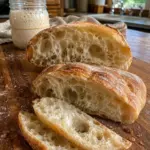
Cool completely on a wire rack before cutting. The best reveal should show a thin golden crust surrounding a glossy, elastic crumb with large and small irregular air pockets throughout.