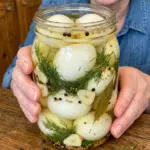
Ingredients
Here’s everything that goes into this garlic dill pickled eggs recipe, along with notes on why each ingredient earns its spot in the jar.
-
- 12 hard-boiled eggs, peeled — The star of the show. Using eggs that are fully cooked and properly peeled (with no stray shell bits) ensures a clean, smooth pickling process and the best final texture.
- 1 cup white vinegar — White vinegar provides the sharp, tangy backbone of the brine and is essential for both flavor and food safety, since the acidity helps preserve the eggs.
- 1 cup water — Water balances out the intensity of the vinegar so the brine isn’t overpoweringly sharp, while still keeping the acidity level high enough for safe pickling.
-
- 1 tbsp pickling salt — Pickling salt (also called canning salt) dissolves cleanly without the additives found in table salt, which can cloud the brine or affect flavor. It also enhances the overall taste of the eggs as they sit in the jar.
- 1 tbsp sugar — A touch of sugar rounds out the sharpness of the vinegar and adds a subtle balance to the brine, without making the eggs taste sweet.
- 6 garlic cloves, sliced — Garlic is one of the two headline flavors in this recipe. Slicing (rather than mincing) allows the garlic to infuse the brine gradually while still looking beautiful in the jar.
-
- 4 fresh dill sprigs — Fresh dill brings that iconic, slightly grassy, aromatic dill pickle flavor that makes these eggs so addictive. It also looks gorgeous suspended in the jar.
- 1 tsp dill seeds — Dill seeds add a more concentrated, slightly warm dill flavor that complements the fresh dill sprigs and deepens the overall taste of the brine.
- 1 tsp black peppercorns — Whole peppercorns infuse the brine with a subtle background heat and earthiness without making the eggs spicy.
- 1 tsp mustard seeds — Mustard seeds add a gentle tang and a little pop of texture, and they’re a classic addition in nearly every good pickling brine.
- 1 bay leaf — Bay leaf contributes a subtle herbal depth that rounds out the other spices and keeps the brine from tasting one-dimensional.
A Quick Note on Choosing and Boiling Your Eggs
For the best results, use eggs that are about a week or so old rather than perfectly fresh eggs straight from the carton — slightly older eggs tend to peel much more easily after boiling, which will save you a lot of frustration. Hard boil your eggs until the yolks are fully set, then cool them quickly in an ice bath before peeling. This makes peeling easier and helps stop the cooking process so you don’t end up with a chalky, overcooked yolk texture.
Instructions
This recipe comes together quickly, with just a few minutes of hands-on prep before the brine and refrigerator do all the real work. Here’s exactly how to make it.
Step 1: Arrange the Eggs in the Jar
Place the peeled hard-boiled eggs into a clean glass jar. A wide-mouth quart jar works especially well here, since it makes it easier to fit the eggs without cracking them.
Step 2: Add the Aromatics
Add the sliced garlic and fresh dill sprigs around the eggs, tucking them into the gaps so the flavor can surround the eggs from every angle.
Step 3: Build the Brine
In a saucepan, combine the white vinegar, water, pickling salt, sugar, dill seeds, black peppercorns, mustard seeds, and bay leaf. Heat over medium heat, stirring occasionally, until the salt and sugar fully dissolve. Be careful not to let the brine come to a boil — you just want it hot enough to dissolve everything and release the aromatics.
Step 4: Pour the Hot Brine Over the Eggs
Carefully pour the hot brine over the eggs in the jar, making sure they are fully submerged. This is one of the most important steps in the whole process — any eggs peeking above the brine line won’t pickle evenly and could spoil faster.
Step 5: Cool the Jar
Let the jar cool to room temperature on the counter before sealing. Pouring a hot lid onto a hot jar and immediately refrigerating can cause condensation buildup, so giving it time to cool first helps keep things food-safe and prevents excess moisture inside the jar.
Step 6: Seal and Refrigerate
Once cooled, seal the jar tightly with a lid and place it in the refrigerator.
Step 7: Let the Magic Happen
Let the eggs pickle for at least 3 days before tasting. For the best, most well-developed garlic and dill flavor, wait 5–7 days before serving. The longer they sit, the more the flavor penetrates into the egg itself.
- Prep Time: 15 minutes
- Cook Time: 5 minutes
Nutrition
- Serving Size: 12 eggs
- Calories: 75 calories per egg