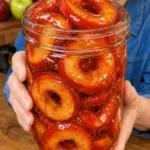
Description
- Prep: About 20 minutes, including drying the fruit
- Candy cooking: About 20 minutes, varying by equipment
- Cooling: About 30 minutes, until fully cool
- Total: Approximately 1 hour 10 minutes
- Servings: About 8
- Method: Hard-candy dipping
- Best served: The day of preparation
Ingredients
Apple Rings
- 4 large firm apples, such as Granny Smith or Honeycrisp
- 4 cups cold water
- 2 tablespoons lemon juice
Cinnamon Candy Coating
- 2 cups granulated sugar
- 1 cup water
- 1/2 cup light corn syrup
- 1 teaspoon ground cinnamon
- 1/2 teaspoon food-grade cinnamon extract suitable for candy making
- 1/2 teaspoon vanilla extract
- Up to 1/2 teaspoon red food coloring, adjusted for product strength
- 1/8 teaspoon cayenne pepper, optional
- A small pinch of salt
For the Tray
- A little neutral oil or cooking spray if lightly greasing parchment
Servings: Approximately eight portions, with the number of rings depending on apple size and how many intact slices remain after coring.
Not all the cooked syrup will necessarily adhere to the apples. The recipe needs enough depth for dipping, so leftover coating is normal. This makes a precise nutrition estimate difficult without measuring the amount actually used.
Instructions
1. Prepare the cooling tray
Set a silicone baking mat on a sturdy rimmed baking sheet, or line the tray with parchment and grease it very lightly. Place it on a heat-safe surface near the dipping station.
Leave enough room for the rings to cool in a single layer without touching. Do not use wax paper, which is unsuitable for this hot candy coating.
2. Core and slice the apples
Wash and dry the apples. Remove the cores with an apple corer, then slice crosswise into rings approximately 1/4 inch thick.
Keep the thickness consistent. Very thin rings can break under the weight of hot syrup; thick rings are harder to coat and eat neatly.
Place the rings in the lemon water briefly while completing the slicing. Remove any broken pieces for another use rather than trying to dip fragile fragments.
3. Drain and dry thoroughly
Drain the rings and lay them between clean towels or sturdy paper towels. Blot both sides, the peel, and the inside of the core opening.
Move them to a dry surface and check again for visible moisture. Do this before the syrup reaches its final temperature, so you are not rushing with a pan of hot candy waiting.
Drying improves handling but does not stop the fruit from releasing juice later. Plan to coat and serve promptly rather than expecting long-term crispness.
4. Dissolve the sugar
Combine the sugar, one cup water, corn syrup, ground cinnamon, salt, and optional cayenne in the saucepan.
Heat over medium heat, stirring gently until the sugar dissolves. Avoid splashing syrup high onto the sides of the pan, where crystals can remain.
Once the syrup is boiling steadily, stop stirring. Keep the thermometer positioned correctly and watch the temperature rise.
5. Cook to hard crack
Cook until the thermometer reaches approximately 300°F at sea level. Hard-crack candy is generally associated with about 300–310°F, as described in the Exploratorium’s candy science guidance.
Do not deliberately push toward the upper end simply to make a harder shell. Carryover heat can continue cooking the syrup after the pan leaves the burner.
At higher elevations, candy endpoints need an altitude-appropriate adjustment. Use reliable local candy-making guidance and a checked thermometer rather than applying the sea-level number without adjustment.
Cooking time varies with pan width, burner output, and batch size. The supplied twenty-minute estimate is a planning guide, not the endpoint.
6. Add flavoring carefully
Remove the saucepan from the heat and let vigorous bubbling subside briefly. Add the premeasured cinnamon extract, vanilla, and coloring carefully, following any specific directions for your chosen flavoring.
Stand back from the pan opening because extracts can bubble or release a strong burst of aroma. Stir gently with a dry, heatproof utensil just enough to distribute the additions.
This differs from boiling the extracts through the entire cooking period. Prolonged heating can reduce aroma, and product instructions should guide when concentrated candy flavoring is added.
7. Dip a test ring
Use a dry heatproof dipping tool or a secure long-handled fork to support one ring. Make sure it will not slip into the syrup before lowering it.
Dip briefly, lift carefully, and allow excess syrup to drip back into the pan. Place on the prepared mat without touching the coating.
Let that ring set while you assess the process. If the coating immediately slides off or the apple breaks, pause rather than rushing through the remaining fruit. Surface moisture, syrup temperature, or tool support may need attention.
8. Coat the remaining rings
Work steadily, coating one ring at a time and spacing them on the tray. Do not dip with your fingers or use a short utensil that brings your hand close to the syrup.
Avoid bringing the lemon-water bowl into the dipping area. Dry tools and dry surfaces reduce the chance of water entering the hot candy.
If the syrup becomes too thick to coat smoothly, warm it gently over low heat just until workable. Do not add water to a pan of very hot concentrated syrup. Stop if it smells burnt or has become excessively dark; reheating cannot reverse scorching.
9. Cool completely
Allow the rings to stand in a single layer until the coating is hard and fully cool. About thirty minutes is a useful planning estimate, but room conditions and coating thickness affect the time.
Do not touch the shell to test it while it may still be hot. A glossy surface does not indicate a safe temperature.
Once completely cool, release gently from the mat. If the rings are very brittle, support the apple rather than pulling upward on one edge of the candy.
10. Serve or refrigerate promptly
Serve soon after cooling for the best chance of a crisp shell. Keep the rings separate rather than piling them into a bowl.
Refrigerate leftovers promptly. Do not leave cut fruit out all day in an attempt to preserve the candy texture. Food safety takes priority over maintaining the brittle coating.